Local hot spots may accelerate fouling, coking, cleaning demand, and unplanned maintenance.
Certified Manufacturer
ISO 9001:2015
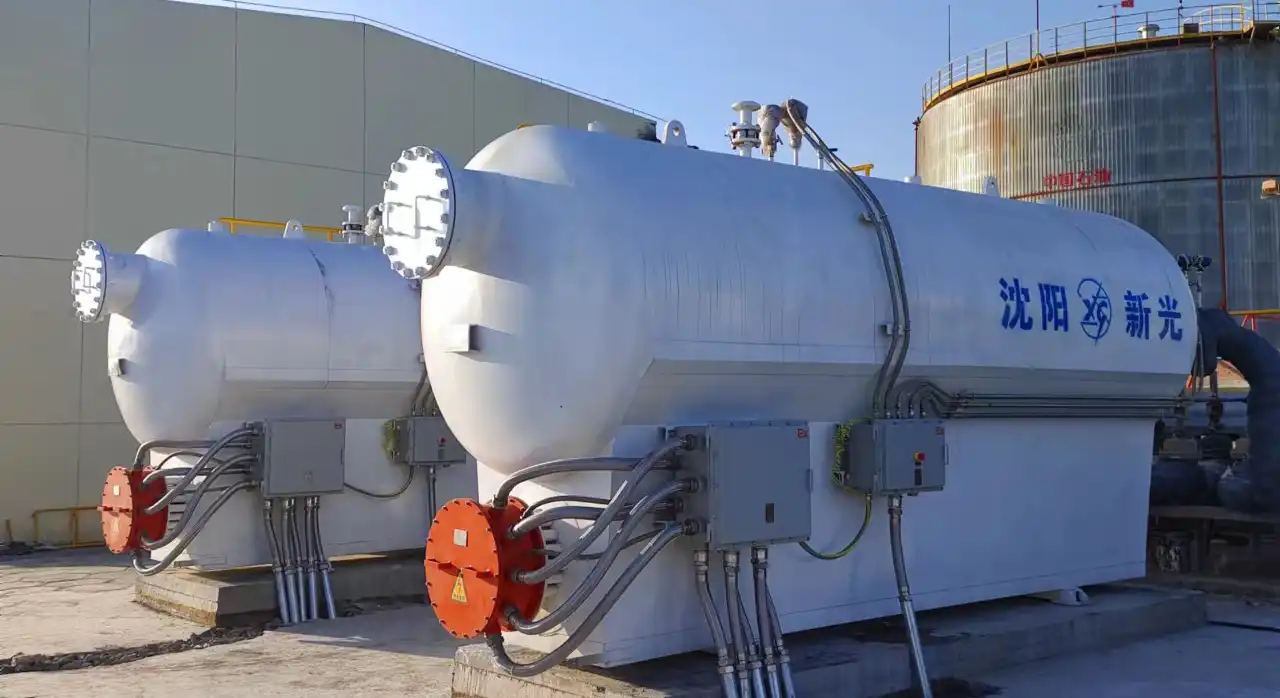
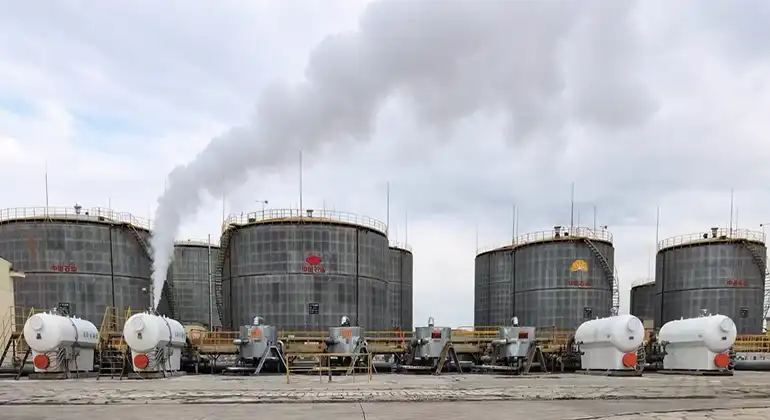
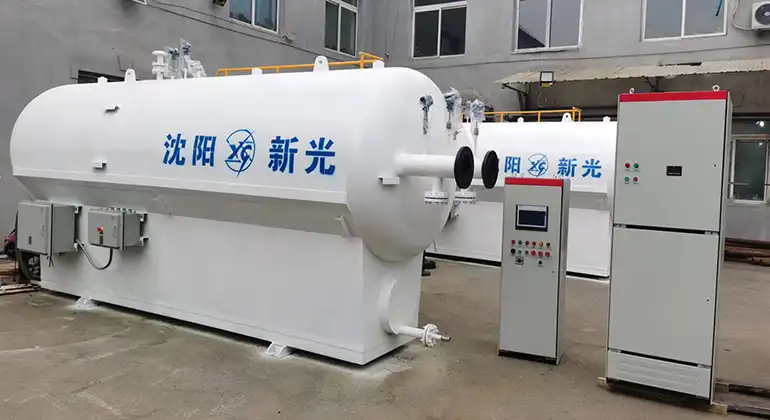
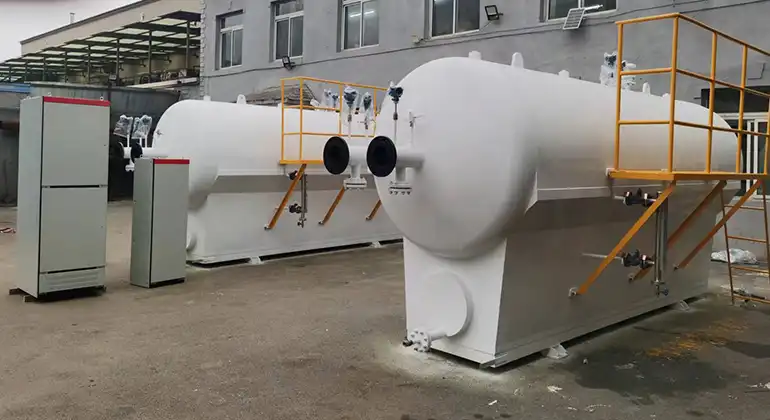
The Vacuum-Assisted Phase-Change Indirect Electric Heater delivers low, uniform wall-temperature preheating for crude oil and multi-phase oilfield media, including crude gathering pipelines, storage tank circulation, upstream heat-exchanger preheating, and separator feed service. Instead of exposing the process stream to a high-temperature electric surface, the heater transfers energy through a sealed vacuum phase-change chamber, creating a gentler and easier-to-control heating path for coking-sensitive oilfield processes.
Electric elements heat a sealed intermediate fluid inside the vessel. Vapor distributes latent heat to the process coil, condenses, and returns by gravity. In low-temperature configurations, vacuum conditions allow water to work as the main phase-change medium in a controlled temperature window, while antifreeze protection can be configured for cold-region service. Indirect heating keeps electric elements isolated from the process stream, reducing direct exposure to hydrocarbons during operation and element maintenance.
These external materials combine general phase-change heat-transfer theory with oil-and-gas references on crude oil fouling, wall temperature, and heat flux. They are provided for technical reading, not as certification of any specific XGTHERMAL product configuration.
Heavy crude and oil-gas-water mixtures can form deposits when they meet localized high-temperature surfaces. In many direct electric or electromagnetic heating routes, raising outlet temperature often means raising the element or wall temperature first. XGTHERMAL's vacuum-assisted phase-change route changes that logic: heat is released by condensing vapor around the process coil, so the crude oil receives more even heat without direct contact with an energized heating element.
Local hot spots may accelerate fouling, coking, cleaning demand, and unplanned maintenance.
In low-temperature duties, vacuum water phase change releases latent heat around the coil for stable, low-fouling heating across crude feed duties, including separator feed service.
Less direct thermal stress on crude oil supports steadier outlet temperature and easier long-term operation.
Spin-flow structure increases residence time and turbulence, while the spiral coil can provide 10–20 times the heat-transfer path of the heater body length. The larger exchange area helps mixed oil-gas-water streams absorb heat more evenly before discharge.
Separator feed remains an important application, but it is not the only service condition. The same low-wall-temperature indirect heating principle can be configured for multiple oilfield gathering, transfer, circulation, and process feed duties.
Supports viscosity control and flow assurance in oilfield gathering and transportation lines.
Maintains temperature during circulation and preservation duties without direct electric exposure to crude oil.
Provides stable crude-oil feed heating upstream of separators where low-fouling operation matters.
Preheats crude or mixed media before heat exchangers and other processing units.
Adapts to multi-phase oilfield feed streams through an indirect process coil and sealed phase-change chamber.
When an existing direct electric, electromagnetic, or immersion-style heater relies on high surface temperature to force heat into crude oil, part of the operating cost is often hidden in overheating, fouling, cleaning, and oversized duty. A vacuum-assisted phase-change route can reduce the direct electricity cost by delivering heat more evenly at the process interface.
Illustration only, not a guaranteed saving. For Central Asia screening, public business electricity prices are around US$0.075/kWh in Uzbekistan and US$0.079–0.086/kWh in Kazakhstan in recent datasets. At US$0.075/kWh, every 100,000 kWh of avoidable heating electricity equals about US$7,500 in annual energy cost. Final savings require the site's flow rate, inlet/outlet temperature, operating hours, fouling history, and actual electricity tariff.
Many legacy vacuum phase-change systems use a burner and fuel-gas system. XGTHERMAL's All-Electric Vacuum-Assisted Phase-Change Heater keeps the familiar indirect phase-change principle, but removes the combustion package from the heater skid.
| Item | Gas-Fired Vacuum Phase-Change Heater | All-Electric Vacuum-Assisted Phase-Change Heater |
|---|---|---|
| Heat source | Burner, fuel-gas train, ignition system, and flue arrangement. | Electric heating elements controlled through PLC + SCR power regulation. |
| Emissions on site | Requires combustion and exhaust handling. | Combustion-free, no on-site flue gas from the heater package. |
| Control response | Depends on burner modulation and combustion-system thermal inertia. | Stepless electric power control helps match heat output to outlet temperature. |
| Site utilities | Requires fuel gas supply and combustion auxiliaries. | Requires suitable electrical capacity and hazardous-area electrical design. |
| Maintenance focus | Burner, flame detection, gas train, and exhaust components need routine attention. | No burner, fuel-gas train, ignition system, or flue arrangement; removable electric elements simplify service. |
| Operating economics | Depends on fuel-gas availability, gas price, maintenance, and operating schedule. | Operating cost depends on local energy prices, but the all-electric route simplifies combustion-system maintenance and digital control. |
For international buyers, this equipment may look close to an indirect electric water-bath heater at first glance. The key difference is the heat-transfer mechanism. A conventional bath relies mainly on sensible heat in the heated bath medium, while the vacuum-assisted design uses evaporation and condensation inside a sealed chamber to move heat rapidly to the process coil.
| Item | Conventional Indirect Water-Bath Heater | Vacuum-Assisted Phase-Change Indirect Heater |
|---|---|---|
| Heat-transfer principle | Sensible heat transfer from heated bath medium to the process coil. | Latent heat transfer through evaporation and condensation in a sealed vacuum chamber. |
| Temperature behavior | Often depends on a larger bulk temperature difference to increase outlet temperature. | Designed to deliver stable heat at a lower, more uniform heating interface. |
| Crude oil suitability | Suitable for general indirect heating where bath inertia and maintenance are acceptable. | Better suited to crude and multi-phase feed heating where low wall temperature, anti-fouling behavior, and stable process conditions matter. |
| Design focus | Simple indirect heating package. | Specialized anti-coking indirect heating package for multi-phase media, separator feed, and general crude preheating processes. |
Recommended for low-temperature crude oil preheating. Glycol-based antifreeze protection can be configured for cold-region service.
Configured for medium-high temperature process heating where a higher phase-change temperature window is required.
Available for special high-temperature duties, with final selection confirmed by process conditions and safety requirements.
Outlet temperature, outlet pressure, shell temperature, element temperature, internal pressure, permissives, alarm handling, and Modbus TCP/IP or Modbus RTU (RS485) communication can be configured according to the approved project basis.
A single international product brochure is being prepared for engineering review, covering the operating principle, typical applications, working-fluid options, and reference configuration.
Key configuration ranges, applicable standards, and typical supply scope for project engineering review.
| Specification Parameters | Specification Details |
|---|---|
| Rated Voltage | AC380V 50HZ (Customizable) |
| Rated Power | 0~3000KW |
| Inlet/Outlet Specification | Customizable according to working conditions |
| Control Mode | PLC, Single-chip Microcomputer, Digital Display Meter (Optional) |
| Alarm Mode | Over-temperature Alarm, Over-pressure Alarm, Low Flow Alarm, Low Liquid Level Alarm, Electrical Fault Alarm (Optional) |
| Design Pressure | 0~45MPa |
| Control Cabinet | Explosion-proof/Non-explosion-proof |
| Protection Class | IP65 |
| Explosion-Proof Grade |
Exdb IIB T1~T6Gb Exdb IIC T1~T6Gb |
| National Standard | Corresponding IEC Standard | Corresponding GOST R Standard |
|---|---|---|
| GB/T3836.1 Explosive Atmospheres - Part 1 | IEC 60079-0:2017 Explosive Atmospheres - Part 0: General Requirements for Equipment | GOST R 51330: This series of standards covers electrical equipment in explosive gas atmospheres, including requirements for design, construction, test methods and marking, equivalent to GB3836.1.2-2021. |
| GB3836.2 Explosive Atmospheres - Part 2: Equipment Protected by Flameproof Enclosures "d" | IEC 60079-1:2014 Explosive Atmospheres - Part 1: Equipment Protected by Flameproof Enclosures "d" | GOST R 51332: This series of standards involves increased safety electrical equipment, similar to GB3836.3-2021, specifying design and construction requirements to prevent ignition in explosive gas atmospheres. |
| Q/SXGBH02-2023 BDRG-□ Explosion-Proof Electric Heater (3000kw) | - | - |
| Q/SXGBH09-2022 BDRG-□ Explosion-Proof Electric Heater (500kw) | - | - |
| Q/SXGBH11-2022 BXM(D)P-WK-□ Series Explosion-Proof Power Distribution Box | - | - |
| Name | Origin/Brand | Remarks |
|---|---|---|
| Shell | Shenyang Xinguang Electric Manufacturing Co., Ltd. | - |
| Heating Element | Shenyang Xinguang Electric Manufacturing Co., Ltd. | - |
| Control Cabinet | Shenyang Xinguang Electric Manufacturing Co., Ltd. | Explosion-proof/Non-explosion-proof |
| Electrical Components | Delixi, Chint | PLC, Circuit Breaker, Contactor, Thyristor, Relay, Isolating Barrier, etc. |
| Instruments | Chuanyi, Anhui Tiankang, Beijing Tiantai | Pressure Transmitter, Temperature Transmitter, Liquid Level Gauge, Flow Meter, etc. |