Oil storage tank heating
Maintains suitable oil temperature for storage, pumping and withdrawal.
 +86 13080774668
 contact@xgthermal.com
 Mon-Fri 9:00-18:00 UTC+8

Certified Manufacturer
ISO 9001:2015
China's Leading
Heating ManufacturerThe Explosion-Proof Immersion Heater is an industrial electric heater engineered for oil storage tanks, drums and process vessels. It provides controlled heat input to support liquid warm-up, temperature maintenance and oil withdrawal in cold conditions. Flanged immersion heater assemblies are configured around the vessel connection, liquid properties and required heating duty.
XGTHERMAL can configure the heating bundle, mounting connection, terminal enclosure and control cabinet for hazardous oilfield areas. The tank-heater design can include a protective sleeve that separates the removable element from the liquid; direct-immersion and sleeved arrangements are reviewed against the project requirements.
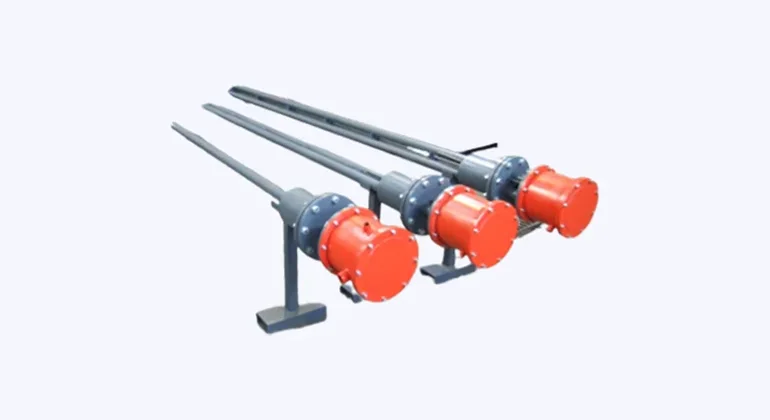
This product is used where a liquid inventory must be warmed or maintained at a suitable temperature. The heating arrangement depends on the fluid, available liquid depth, tank geometry and operating cycle.
Maintains suitable oil temperature for storage, pumping and withdrawal.
Supports viscosity reduction before transfer, with heat load matched to the oil.
Adds controlled heat to a liquid inventory during holding or batch operation.
Provides planned warm-up for cold liquids, accounting for insulation and heat loss.
Can be evaluated for collected liquids where minimum level and sediment clearance are defined.
Tank heating is rarely only about reaching a bulk liquid temperature. A heater must transfer heat within the available liquid depth while accounting for viscosity, natural convection, deposits and hazardous-area requirements.
Limited movement around the heating surface can slow warm-up and increase local temperature.
Heating area, immersion length and watt density are selected around liquid properties and the working level.
Level and temperature interlocks help protect exposed heating surfaces and limit overheating.
The assembly fits into the tank or vessel through a project-selected connection. In a direct-immersion design, the element sheath contacts the liquid. In a sleeved tank heater, heat passes through a separate sleeve while the element remains isolated from the process liquid. The arrangement is confirmed before manufacture.
A tank heater needs protection beyond the normal temperature controller. Project-specific controls can regulate heating output and interrupt power when liquid level, surface temperature or electrical conditions move outside the permitted operating range.
Liquid-temperature feedback can be used for automatic heating adjustment and operator visibility.
Power output can be adjusted smoothly to reduce thermal shock and unnecessary cycling.
Heating is inhibited below the permitted liquid level to help prevent dry firing and exposed hot surfaces.
Separate high-limit protection can monitor the heating assembly, alongside electrical faults and vessel-pressure signals where required.
Specifications are configured to your operating conditions. Maximum ratings may not apply simultaneously.
| Specification Parameters | Specification Details |
|---|---|
| Rated Voltage | AC 380 V, 50 Hz (customizable) |
| Rated Power | Up to 200 kW |
| Inlet/Outlet Specification | Custom mounting flange / nozzle |
| Control Mode | PLC / microcontroller / digital controller (optional) |
| Alarm Mode | Over-temperature, low liquid level, electrical faults; optional pressure / flow alarms |
| Design Pressure | 0–45 MPa |
| Control Cabinet | Explosion-proof / non-explosion-proof |
| Protection Class | IP65 |
| Explosion-Proof Grade | Exdb IIB T1~T6Gb Exdb IIC T1~T6Gb |
| Standards and Certification Area | Reference / Route | How XGTHERMAL Supports It |
|---|---|---|
| Explosion-proof design basis | IEC 60079 / GB/T 3836 | Design reference for the terminal enclosure and hazardous-area electrical details of the heater assembly. |
| EU / international Ex certification | ATEX / IECEx | Project-specific certification route can be supported when required by the destination market and final hazardous-area classification. |
| Eurasian market access | EAC / TR CU 012/2011 | Certification and technical documentation support can be coordinated for Russia, Kazakhstan and other EAEU destinations. |
| Oil & gas procurement documents | IOGP JIP33 S-723 Electrical Process Heaters | JIP33-aligned data sheets, inspection and test plans, vendor document register and technical query response can be prepared for EPC review. |
| Pressure boundary | ASME BPVC Section VIII / PED 2014/68/EU | Pressure-boundary design, material traceability and third-party review can be supported for the mounting flange, sleeve or assembly where included in project scope. |
| Electrical cabinet and machine safety | IEC 61439 / IEC 60204-1 | Control cabinet layout, component selection, wiring practice and electrical protection can be configured around project requirements. |
| Functional safety | IEC 61511 / SIL | SIL-rated safety loop design can be coordinated when independent shutdown or safety instrumented functions are specified. |
| Sour service materials | ISO 15156 / NACE MR0175 | Wetted material selection can be reviewed for H2S-containing fluids within the applicable standard and project scope. |
| Inspection and handover package | EN 10204 3.1, NDT reports and FAT records | Material certificates, pressure test records, non-destructive testing reports, electrical test records and factory acceptance test files can be supplied. |
| Ingress protection | IEC 60529 | IP65 / IP66 enclosure protection can be selected for outdoor oilfield stations and harsh operating environments. |
Certification availability depends on final equipment configuration, destination market requirements, hazardous-area classification and third-party conformity assessment. Standards listed here describe available engineering and documentation support, not a blanket certificate for every configuration.
| Name | Origin/Brand | Remarks |
|---|---|---|
| Heater Assembly | Shenyang Xinguang Electric Manufacturing Co., Ltd. | Mounting flange, bundle and protective sleeve where specified |
| Heating Element | Shenyang Xinguang Electric Manufacturing Co., Ltd. | Sheath material, heated length and surface heat load selected for the liquid |
| Control Cabinet | Shenyang Xinguang Electric Manufacturing Co., Ltd. | Explosion-proof or safe-area cabinet available |
| Electrical Components | Delixi, Chint or project-approved equivalents | PLC, circuit breaker, contactor, thyristor, relay and isolating barrier options |
| Instruments | Chuanyi, Anhui Tiankang, Beijing Tiantai or project-approved equivalents | Liquid temperature, high-limit and level instruments; pressure / flow where required |



XGTHERMAL has supplied electric heating systems for projects connected with CNPC / PetroChina, PipeChina and Sinopec. In China’s petroleum and petrochemical sectors, qualified heater suppliers must pass technical review, explosion-proof compliance checks, safety documentation review and field performance verification.
This project record places XGTHERMAL among the specialist electric heating manufacturers trusted for demanding oil and gas applications. Redacted cooperation records, contract references or project supporting materials can be provided for qualified procurement discussions.
Share the liquid, duty range, vessel drawing and control requirements. XGTHERMAL can configure the immersion heater assembly around your operating conditions and installation limits.
