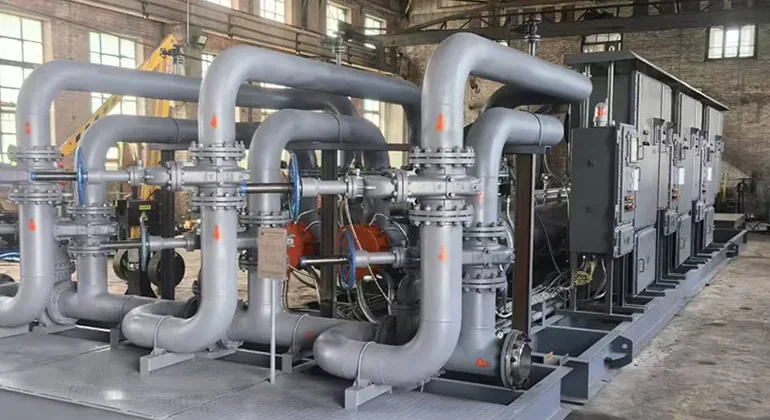
Crude oil gathering and transfer
Raises fluid temperature for transfer through oilfield gathering and station piping.
The Explosion-Proof Induction Heater uses electromagnetic induction to heat a metal core tube, which transfers heat to flowing crude oil or produced fluid. Also known as an electromagnetic pipeline heater, it keeps the induction winding separate from the process fluid and uses a return-flow arrangement to distribute heat along the heating section.
XGTHERMAL manufactures induction process heaters in China for oilfield gathering and transfer stations, including water-cut crude oil service. The heater body, coil arrangement, insulation and controls are configured around the fluid properties and site conditions, with multi-unit skid packages available for larger heating duties.
The main application is controlled heating of crude oil and produced liquids before transfer or separation. Water cut, viscosity, sand content and scaling tendency are reviewed together with the required temperature rise and operating flow range.
Raises fluid temperature for transfer through oilfield gathering and station piping.
Matches heat input to changing oil-water composition and the required outlet temperature.
Preheats produced liquids to the temperature specified for the downstream separation process.
Supports viscosity control in winter, with insulation and freeze protection selected for the site.
Heating passages and drain access are reviewed for solids-bearing fluids and planned cleaning.
Sand and scale can restrict flow and impair heat transfer, while a poorly matched heating surface can develop hot spots. The technical design combines an extended heating section, distributed coil winding and accessible drainage to address these practical oilfield operating concerns.
Cold crude and entrained sand can complicate flow distribution and maintenance.
Coil layout, heating length and fluid passages are selected together for the process duty.
Deposits or low flow can increase wall temperature even when the bulk outlet temperature appears normal.
An alternating magnetic field induces currents in the metal core tube, producing heat in the metal itself. Fluid follows the designed internal passage and return path around the heating section. The coil is isolated from the process fluid, but the heated metal wall remains a wetted heat-transfer surface and still requires temperature and no-flow protection.
PLC temperature regulation is combined with shell and core temperature monitoring. Normal control, early warning and protective shutdown have different roles: a cleared first-stage alarm is not the same as permission to restart after a latched over-temperature trip.
Measured temperature is compared with the setpoint; a 4–20 mA command regulates the power-control stage.
Local controls and remote start / stop can be provided, with RS485 MODBUS-RTU communication to station SCADA or DCS.
First-stage warnings and second-stage high-temperature trips provide distinct responses. Latched trips require manual reset after the cause is checked.
Flow, pressure and electrical-fault protection are selected for the installation. Power-factor compensation and harmonic filtering may be configured for the site network; neither replaces temperature or no-flow protection.
The ranges below describe configurable heater units. Larger duties can use a multi-unit package, such as the 600 kW Xinjiang project. Final ratings, Ex marking and supplied documents are confirmed for the selected configuration.
| Specification Parameters | Specification Details |
|---|---|
| Rated Voltage | AC 380 V, 50 Hz (customizable) |
| Rated Power | Up to 500 kW per unit |
| Inlet/Outlet Specification | Custom flange / nozzle sizes |
| Control Mode | PLC / microcontroller / digital controller (optional) |
| Alarm Mode | Shell / core over-temperature; flow, pressure and electrical faults |
| Design Pressure | Up to 9.9 MPa |
| Control Cabinet | Explosion-proof / non-explosion-proof |
| Protection Class | IP65 |
| Explosion-Proof Grade | IIB / IIC; temperature class by configuration |
| Standards and Certification Area | Reference / Route | How XGTHERMAL Supports It |
|---|---|---|
| Explosion-proof design basis | IEC 60079 / GB/T 3836 | Applicable requirements for the induction heating assembly, enclosure, terminals and hazardous-area electrical equipment. |
| EU / international Ex certification | ATEX / IECEx | Project-specific certification route can be supported when required by the destination market and final hazardous-area classification. |
| Eurasian market access | EAC / TR CU 012/2011 | Certification and technical documentation support can be coordinated for Russia, Kazakhstan and other EAEU destinations. |
| Oil & gas procurement documents | IOGP JIP33 S-723 Electrical Process Heaters | S-723 primarily covers resistance-type heater bundles. Relevant procurement clauses may be reviewed with the EPC for an induction package; no blanket S-723 compliance is implied. |
| Pressure boundary | ASME BPVC Section VIII / PED 2014/68/EU | Pressure design, material traceability, welding records and third-party review can be supported when the heater body is within project pressure-equipment scope. |
| Electrical cabinet and machine safety | IEC 61439 / IEC 60204-1 | Control cabinet layout, component selection, wiring practice and electrical protection can be configured around project requirements. |
| Functional safety | IEC 61511 / SIL | SIL-rated safety loop design can be coordinated when independent shutdown or safety instrumented functions are specified. |
| Sour service materials | ISO 15156 / NACE MR0175 | Material selection can be reviewed for H2S or sour crude service when required by the process medium. |
| Inspection and handover package | EN 10204 3.1, NDT reports and FAT records | Material certificates, pressure test records, non-destructive testing reports, electrical test records and factory acceptance test files can be supplied. |
| Ingress protection | IEC 60529 | IP65 / IP66 enclosure protection can be selected for outdoor oilfield stations and harsh operating environments. |
Certification availability depends on final equipment configuration, destination market requirements, hazardous-area classification and third-party conformity assessment. Standards listed here describe available engineering and documentation support, not a blanket certificate for every configuration.
| Name | Origin/Brand | Remarks |
|---|---|---|
| Heater Body | Shenyang Xinguang Electric Manufacturing Co., Ltd. | Pressure boundary and process connection customized by project |
| Induction Heating Assembly | Shenyang Xinguang Electric Manufacturing Co., Ltd. | Heating tube, winding and insulation configured for duty and fluid properties |
| Control Cabinet | Shenyang Xinguang Electric Manufacturing Co., Ltd. | Explosion-proof or safe-area cabinet available |
| Electrical Components | Delixi, Chint or project-approved equivalents | PLC, power regulator, breakers, contactors, relays and filtering options |
| Instruments | Chuanyi, Anhui Tiankang, Beijing Tiantai or project-approved equivalents | Temperature, pressure, flow and level instruments configured by process design |
XGTHERMAL has supplied electric heating systems for projects connected with CNPC / PetroChina, PipeChina and Sinopec. In China’s petroleum and petrochemical sectors, qualified heater suppliers must pass technical review, explosion-proof compliance checks, safety documentation review and field performance verification.
This project record places XGTHERMAL among the specialist electric heating manufacturers trusted for demanding oil and gas applications. Redacted cooperation records, contract references or project supporting materials can be provided for qualified procurement discussions.
Share the operating conditions, installation limits and control requirements. XGTHERMAL can configure the heater body or integrated skid and define the mechanical, electrical and station-control interfaces with your team.