• Certified

    Certified Manufacturer

    ISO 9001:2015
  • Leading

    China's Leading

    Heating Manufacturer

Oilfield Sand-Settling Electric Heater

Heating for sand-bearing produced fluids

XGTHERMAL’s Oilfield Sand-Settling Electric Heater combines vacuum-assisted phase-change indirect heating, pipeline swirl technology and dedicated sediment-collection space for sand-bearing crude oil and produced liquids. Collected solids are removed through scheduled blowdown.

Manufactured in China for oilfield gathering stations, the system uses PLC temperature control. Heating duty, fluid passages, settling space and drain access are configured around viscosity, flow rate and solids loading, so heating and sediment removal can be planned together.

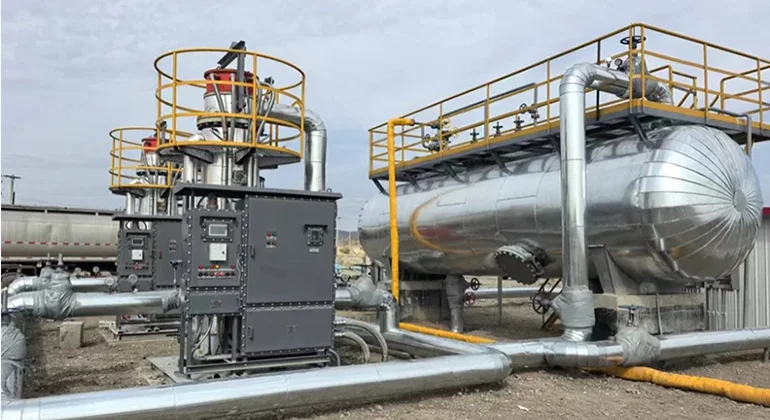
XGTHERMAL oilfield sand-settling electric heating equipment with process vessels, piping and control cabinet
Indirect Electric Heating Phase-change heat transfer separates electric elements from the crude oil
Dedicated Settling Space Provision for sediment collection within the process arrangement
Planned Blowdown Collected solids removed at intervals matched to operating conditions
Typical applications

Heating and sediment management at gathering stations.

This configuration is intended for gathering-station duties where sand accumulation complicates routine heating and maintenance. Selection starts with the produced-fluid composition and the solids to be managed, as well as the required outlet temperature.

Sand-bearing crude oil heating

Combines a controlled heat source with provision for collecting entrained sediment.

Produced-liquid temperature conditioning

Raises oil-water mixture temperature to the target specified for the gathering process.

Viscous crude oil handling

Supports fluidity while allowing solids accumulation and cleaning access to be considered.

Seasonal temperature variation

Matches the heating arrangement and insulation to changing inlet and ambient temperatures.

Gathering-station heating upgrades

For projects where an existing heating arrangement needs better provision for sediment collection and removal.

Heating challenges

Heat the liquid. Make provision for the solids.

Sand can accumulate in process equipment and restrict flow. Heating supports crude oil fluidity, but it does not remove the solids on its own. The design therefore combines a controlled heat source with space to collect sediment and a planned route for removing it.

Process challenge Sand carried with produced liquids

Changing solids concentration and viscosity affect how sediment moves and accumulates.

XGTHERMAL design focus Heating, settling space and blowdown

The thermal duty and sediment-handling arrangement are selected as related but distinct requirements.

Operational risk Accumulation and restricted flow

Collected sediment must be removed before it compromises usable collection space or the process path.

  • Particle size, concentration and fluid viscosity are needed to assess the settling arrangement.
  • Heat-transfer walls still need protection against deposits, abnormal temperature and inadequate flow.
  • Blowdown access, isolation and a suitable discharge destination are part of the operating plan.
Oilfield sand-settling heating installation showing vessels, service access and control equipment
Engineering design

Indirect heat transfer with space for sediment collection.

Electric elements heat an intermediate phase-change medium, which transfers heat indirectly to the process fluid through a separate heat-transfer surface. The process-side arrangement combines pipeline swirl features with sand-settling space and blowdown access. The heating circuit and the process-fluid pressure boundary are reviewed separately during engineering.

  • Process-side materials and passages reviewed for erosion, deposits and fluid compatibility
  • Intermediate heating medium and heat-transfer area selected for the required duty
  • Settling space and drain access matched to the expected solids loading and removal plan
  • Instrumentation, insulation and cabinet arrangement coordinated with site requirements
Control and protection

Temperature control with protection for both circuits.

PLC control regulates the heating process, while selected instruments monitor temperature, pressure and operating conditions. Sediment removal is a separate operating task: the blowdown sequence, isolation arrangement and discharge destination must be defined for the installation.

PLC temperature regulation

Process temperature feedback supports controlled heat input and local operating visibility.

Independent temperature protection

High-limit monitoring is configured separately from normal temperature regulation for the selected heating arrangement.

Flow and heating-medium level

Flow and liquid-level alarms or interlocks can be selected to inhibit heating under unsuitable conditions.

Pressure protection and blowdown coordination

Process-side and heating-circuit pressure protection are reviewed separately. Electrical-fault trips and the agreed blowdown operating sequence complement the temperature controls; automatic sand discharge is not assumed.

Engineering data

Specifications

Final duty, process-side pressure, phase-change circuit conditions and Ex marking are confirmed for the selected configuration. Solids capacity and blowdown requirements are determined from the project fluid data.

  • Specifications
  • Standards & Certification
  • Supply Scope
Specification Parameters Specification Details
Rated Voltage AC 380 V, 50 Hz (customizable)
Rated Power Up to 500 kW
Inlet/Outlet Specification Custom flange / nozzle sizes
Control Mode PLC / microcontroller / digital controller (optional)
Alarm Mode Temperature, pressure, flow, level and electrical faults (optional)
Design Pressure Project-specific pressure rating
Control Cabinet Explosion-proof / non-explosion-proof
Protection Class IP65
Explosion-Proof Grade IIB / IIC; temperature class by configuration
Standards and Certification Area Reference / Route How XGTHERMAL Supports It
Explosion-proof design basis IEC 60079 / GB/T 3836 Applicable requirements for electrical heating components, terminals, cabinets and other hazardous-area equipment.
EU / international Ex certification ATEX / IECEx Project-specific certification route can be supported when required by the destination market and final hazardous-area classification.
Eurasian market access EAC / TR CU 012/2011 Certification and technical documentation support can be coordinated for Russia, Kazakhstan and other EAEU destinations.
Oil & gas procurement documents IOGP JIP33 S-723 Electrical Process Heaters Applicable procurement clauses and documentation can be reviewed with the EPC. The indirect heating and settling package requires a scope review; S-723 does not establish sand-separation performance.
Pressure boundary ASME BPVC Section VIII / PED 2014/68/EU Process-side and heating-circuit pressure boundaries, material traceability, welding records and applicable conformity assessment are reviewed for the destination market.
Electrical cabinet and machine safety IEC 61439 / IEC 60204-1 Control cabinet layout, component selection, wiring practice and electrical protection can be configured around project requirements.
Functional safety IEC 61511 / SIL SIL-rated safety loop design can be coordinated when independent shutdown or safety instrumented functions are specified.
Sour service materials ISO 15156 / NACE MR0175 Material selection can be reviewed for H2S or sour crude service when required by the process medium.
Inspection and handover package EN 10204 3.1, NDT reports and FAT records Material certificates, pressure test records, non-destructive testing reports, electrical test records and factory acceptance test files can be supplied.
Ingress protection IEC 60529 IP65 / IP66 enclosure protection can be selected for outdoor oilfield stations and harsh operating environments.

Certification availability depends on final equipment configuration, destination market requirements, hazardous-area classification and third-party conformity assessment. Standards listed here describe available engineering and documentation support, not a blanket certificate for every configuration.

Name Origin/Brand Remarks
Heater Body Shenyang Xinguang Electric Manufacturing Co., Ltd. Process body, settling space and connections configured by project
Heating Element Shenyang Xinguang Electric Manufacturing Co., Ltd. Electric elements matched to the intermediate heating medium and duty
Control Cabinet Shenyang Xinguang Electric Manufacturing Co., Ltd. Explosion-proof or safe-area cabinet available
Electrical Components Delixi, Chint or project-approved equivalents PLC, circuit breaker, contactor, thyristor, relay and isolating barrier options
Instruments Chuanyi, Anhui Tiankang, Beijing Tiantai or project-approved equivalents Process and heating-circuit temperature, pressure, flow and level monitoring
Operator references

One of China’s Top-Tier Electric Heating Suppliers for Oil & Gas Projects

XGTHERMAL has supplied electric heating systems for projects connected with CNPC / PetroChina, PipeChina and Sinopec. In China’s petroleum and petrochemical sectors, qualified heater suppliers must pass technical review, explosion-proof compliance checks, safety documentation review and field performance verification.

This project record places XGTHERMAL among the specialist electric heating manufacturers trusted for demanding oil and gas applications. Redacted cooperation records, contract references or project supporting materials can be provided for qualified procurement discussions.

Custom engineering

Custom engineering around your operating conditions.

Share the operating conditions, installation limits and control requirements. XGTHERMAL can configure the equipment and define the process connections, electrical interfaces and maintenance access with your team.

  • Process medium Produced-fluid composition, water cut, sand loading and fouling tendency.
  • Mechanical interface Process connections, pressure ratings, footprint and blowdown access.
  • Site safety Hazardous-area classification, IP protection, grounding and interlock requirements.
  • Controls Local HMI, station signals, temperature control and interlock requirements.
Sizing & RFQ Guidance

Help us specify your sand-settling heater.

Thermal sizing starts from Q = ṁ × Cp × ΔT. Sand-settling selection also needs particle-size distribution, solids loading, fluid viscosity and flow variation. These determine the review of collection space, internal flow conditions and the planned blowdown interval.

  • Produced-fluid composition and water cut
  • Normal flow rate and operating schedule
  • Minimum / maximum flow and transient conditions
  • Inlet and target outlet temperature
  • Design pressure and flange standard
  • Allowable pressure drop
  • Viscosity, wax, scale and emulsion characteristics
  • Sand concentration and particle-size distribution
  • Hazardous-area classification
  • Solids-removal target and available blowdown destination
  • Power supply and site electrical limits
  • Installation space, inspection access and maintenance intervals
  • Local / remote controls and station interlocks
Technical FAQ

Common engineering questions.

Is this the same as a dedicated oilfield desander?

A sand-settling heater combines heating with space for sediment collection and removal. A dedicated desander is selected around separation performance. Where an outlet-solids limit or particle cut size is specified, the complete separation duty must be assessed; heating power alone cannot establish that performance.

Which fluids and solids can be evaluated?

The intended service includes sand-bearing crude oil and produced liquids at gathering stations. Suitability depends on particle sizes, concentration, water cut, viscosity, flow range and fouling behavior. Fine suspended solids and emulsions require separate process evaluation rather than an assumption of complete removal.

Do the electric elements contact crude oil directly?

Electric heating elements act on an intermediate phase-change medium rather than being immersed directly in the crude oil. The process fluid still contacts a heat-transfer wall, so deposit buildup and abnormal wall temperature must be considered during selection and operation.

Is sand discharge automatic or continuous?

The existing product design provides sand-settling space and periodic blowdown. The removal interval depends on actual solids accumulation and operating conditions. Automatic valve sequencing or continuous discharge should only be included when specifically engineered and agreed; it is not assumed as standard.

Do you supply sand-settling heaters from China?

Yes. XGTHERMAL is a China-based manufacturer of electric heaters and integrated heating equipment for oilfield gathering stations. We support project-specific configuration, technical documentation and overseas procurement discussions for sand-bearing fluid heating duties.

What certification documents can be supported?

The documentation package can include applicable Ex assessment, material certificates, pressure and electrical test records, and FAT documentation. Destination-specific ATEX, IECEx or EAC routes are agreed for the final equipment. Certificates for one configuration do not automatically cover every project.

Request the sand-settling heater datasheet

Share your operating conditions and our team can provide a project-specific datasheet or preliminary selection notes.

Request Datasheet

Have a project requirement or need a custom heating solution?
Contact XGTHERMAL for technical support, OEM service, or a quotation.