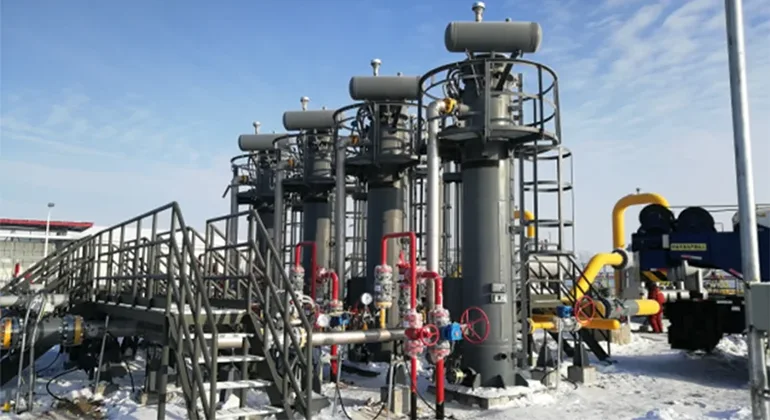
Laha Offtake Station
- Heating capacity
- 205 kW
- Maximum daily throughput
- 966,600 Nm³/day
- Cabinet access
- Single-front-door, wall-side installation

 +86 13080774668
 contact@xgthermal.com
 Mon-Fri 9:00-18:00 UTC+8

Certified Manufacturer
ISO 9001:2015
China's Leading
Heating Manufacturer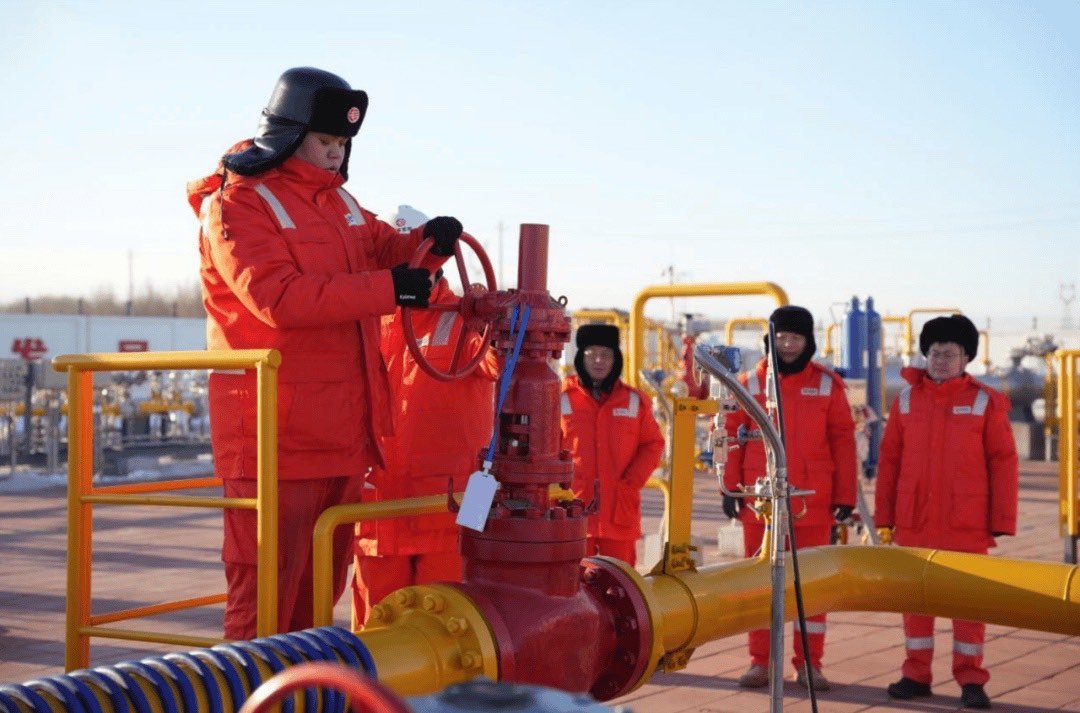
The Nenjiang Branch is a supporting branch of the China–Russia East Route natural gas pipeline. It passes through Fuyu County, Nehe City, and Nenjiang City, using D508 mm and D219.1 mm pipe sections with an annual design transmission capacity of 8.63 × 10⁸ Nm³. The line includes three process stations and five monitored valve chambers.
XGTHERMAL supplied three horizontal indirect thermal-oil electric heating packages for the route. The systems were sized by station duty, with outdoor heater packages, indoor control cabinets, layered protection, Modbus RTU communication, and PIM-ready digital handover materials.
Each station received the same indirect heating philosophy, while capacity and cabinet access were matched to the station duty.
The new stations needed a heating package that could operate reliably in a severe winter pipeline environment.
The project used indirect thermal-oil heating to separate combustible gas from electric heating elements while keeping control logic consistent across all stations.
After commissioning, the three heating packages provide a stable temperature-lift point for the Nenjiang Branch stations during the long winter operating season. By raising the outlet gas temperature after pressure regulation, the system helps reduce the risk of low-temperature freeze blockage and supports continuous gas delivery across the 195 km branch line.
The different heater capacities were selected around the actual station duties rather than treated as a single repeated unit. Laha Offtake Station received the 205 kW package for the highest daily throughput, Nehe Offtake & Pigging Station received the 135 kW package, and Nenjiang Terminal Station received the 65 kW package. This sizing strategy keeps the installation consistent while avoiding unnecessary installed power at the lower-flow station.
The project uses an indirect thermal-oil heating arrangement so that combustible natural gas is physically separated from the electric heating elements. For hazardous-area pipeline stations, this separation gives the control system clearer protection boundaries and reduces the risk associated with direct contact between gas and energized heating components.
Each heater package combines five Pt100 temperature measurement points with two independent overtemperature stages, a low-flow shutdown permissive, and a highest-priority ESD circuit. The protection logic is designed so that critical shutdown functions do not rely only on normal temperature-control operation. Local control remains available at the cabinet, while RS485 Modbus RTU communication allows station SCADA to receive temperature, fault, running status, remote start/stop, ESD, and energy-consumption data.
Beyond the heater bodies, the delivery package included indoor control cabinets, explosion-protected junction boxes, low-temperature-rated power and signal cables, paired flanges, fasteners, gaskets, field instruments, installation accessories, commissioning spares, and maintenance tools. The equipment-side electrical enclosures were specified for IP65 field protection, while the indoor control cabinet used an IP55 enclosure strategy.
The handover package also supported PipeChina-style lifecycle management through structured equipment data, as-built drawings, test reports, material certificates, a 1:1 three-dimensional model, QR code identification, and RFID asset tagging. This makes the case useful not only as a cold-climate heating project, but also as an example of packaged electric heating equipment supplied with digital documentation for long-term pipeline asset management.
A directly relevant product family for natural gas pipeline heating and freeze protection.