Sand-Laden Fluid
Entrained solids enter with the production stream.
 +86 13080774668
 contact@xgthermal.com
 Mon-Fri 9:00-18:00 UTC+8


Certified Manufacturer
ISO 9001:2015
China's Leading
Heating ManufacturerHeating oilfield production fluids with significant sand content requires more than sufficient heating duty.
Flow path, solids accumulation, settling space and solids removal must also be considered in the heater design.
Sand and other entrained solids can enter the heater with the production fluid. Particle loading, flow conditions, internal geometry and the operating regime influence where solids may accumulate.
Entrained solids enter with the production stream.
Solids may collect in low-flow or poorly swept regions.
Accumulation can reduce the available flow area.
Blockage risk and maintenance needs may increase.
Conceptual progression, not a specific heater. Accumulation and blockage depend on field conditions and are not inevitable.
A thermal calculation establishes the required heat input. It does not establish how entrained solids will move, collect or be removed.
A heater can meet the thermal duty and still experience solids-related operating problems.
If solids enter the heater, the design must consider where they can accumulate and how they can be removed. A dedicated lower settling space provides a location for collected material under suitable conditions.
Conceptual solids-management principle — not to scale and not a specific equipment drawing. Connections indicate process functions, not a nozzle arrangement.
Internal flow geometry influences both heat transfer and where entrained solids tend to accumulate.
Poorly swept regions can retain solids. A more continuous active flow path, with a defined collection and removal area, can help manage accumulation.
Generic conceptual flow paths—not equipment drawings or a universal comparison of horizontal and vertical heaters. Suitability depends on the fluid, particles and operating conditions.
The appropriate strategy depends on actual field conditions and may combine more than one approach. A new heater is not always the only answer.
Where sand loading or process conditions justify it, solids can be removed before fluid enters the heater. Historical XGTHERMAL guidance recommended upstream wellhead desanding for some existing Mahu installations.
A dedicated volume provides a location for accumulated solids and a periodic discharge route. This is the approach associated with XGTHERMAL’s sand-settling heater; it does not imply complete sand separation.
Existing equipment may still need inspection, blowdown, cleaning and maintenance. Historical first-party guidance also recommended periodic cleaning for existing pipeline heaters, based on actual sand production and operating experience.
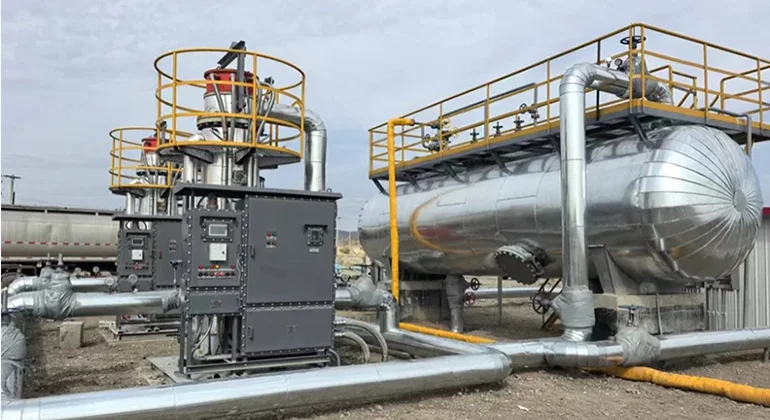
XGTHERMAL’s vertical sand-settling electric heater combines the heating duty with a solids-management approach for sand-bearing oilfield production streams.
The written product description establishes the heating architecture; the photograph provides field-installation context, not evidence of hidden internal features.
Pipeline swirl / flow-path design is considered alongside solids transport and settling requirements.
An intermediate phase-change medium transfers heat indirectly to the process fluid.
Provides a defined volume for accumulated solids. Capacity and discharge planning depend on field conditions.
Provides a means of removing collected material as an operating task—not automatic sand removal.
Supports controlled heater operation; solids-removal procedures remain part of the operating strategy.
Share the available fluid, particle and operating information so heating and solids management can be evaluated together.
Where does the sand accumulate in your existing system?
Practical answers about heating, sand accumulation and solids management in oilfield production systems.
Entrained sand can accumulate in low-flow or poorly swept regions, depending on particle loading, fluid properties, internal geometry and operating conditions. Accumulation may restrict the flow path, increase blockage risk or make maintenance more frequent.
No. Heating changes the thermal condition of the production fluid; it does not itself remove entrained solids. Solids management requires an appropriate collection, separation or removal strategy.
It is a dedicated volume where solids can collect under suitable settling conditions, with provision for removing the accumulated material. Its suitability depends on particle characteristics, fluid behavior, flow conditions and available volume; it does not guarantee complete separation.
Not necessarily. The appropriate approach depends on sand loading, particle characteristics, process configuration and maintenance strategy. Upstream solids removal and integrated settling can serve different functions and may sometimes be used together.
There is no universal interval. It depends on actual solids production, operating conditions, available settling volume and field operating history. The discharge procedure and interval should be established for the installation and reviewed against observed accumulation.
Provide fluid composition and viscosity, heating temperatures, flow and pressure, sand concentration, particle information and production variability. Existing heater details, blockage history, cleaning records and photographs of accumulated solids help define an appropriate approach.
Share your field conditions and operating history. Our engineering team can help evaluate the heating duty and solids-management approach for your application.
