Solar Thermal Heating
Typical indirect heat-transfer route
- Sunlight
- Solar thermal collector
- Heat-transfer circuit
- Process heat

ISO-Certified Manufacturer
ISO 9001 · 14001 · 45001Electric Heating Expertise
Manufacturing Since 1992Project-engineered DC electric heating for integrating photovoltaic electricity with industrial process heat.
Typical indirect heat-transfer route
Solar electricity supplied to an engineered heating system
Solar thermal collectors capture heat and deliver it through a heat-transfer circuit—for example, water or thermal oil selected for the operating temperature. This is a typical indirect arrangement; other solar thermal configurations are possible. PV modules generate electricity, which supplies an electric heater through a project-engineered power, control and protection system.
A complete PV-to-heat solution includes power generation, electrical distribution, heating equipment, the process load and plant controls. XGTHERMAL focuses on the heater-side system and its agreed interfaces.
Project power-system scope
XGTHERMAL heater-side engineering & interfaces
Supply boundaries are agreed for each project. PV modules, complete PV EPC, site-wide MPPT / inverter systems, BESS and plant-wide EMS are not part of XGTHERMAL’s normal scope unless specifically agreed. The process load and plant control system are shown as interfaces, not as an implied equipment supply.
Photovoltaic output varies with irradiation and operating conditions. The heater must work within a defined DC voltage and current envelope, with DC-rated switching, isolation and protection coordinated with the upstream supply.
Controlled heater power, temperature feedback and process-safety interlocks must work together across the operating range. The electrical route alone does not establish stable temperature control.
Direct DC does not automatically mean inverter-free, converter-free, MPPT-free or power-electronics-free. Upstream topology remains project-specific.
The architecture is selected around the available power system, heating duty and operating strategy. These three arrangements illustrate different electrical relationships.
A dedicated PV supply feeds the heater through an engineered DC electrical architecture.
PV and/or other DC sources feed a common industrial DC bus; the heater is one connected load.
PV and plant power converge through a coordinated electrical supply and control architecture.
Conceptual integration arrangements only, not three configurations delivered in the PV-powered industrial air heating project. Supply compatibility, conversion stages, protection and operating strategy require project-specific engineering.
Solar electric process heat is a Power-to-Heat (P2H) application. Final suitability depends on actual site, electrical and process conditions, including the relationship between available PV power and heating demand.
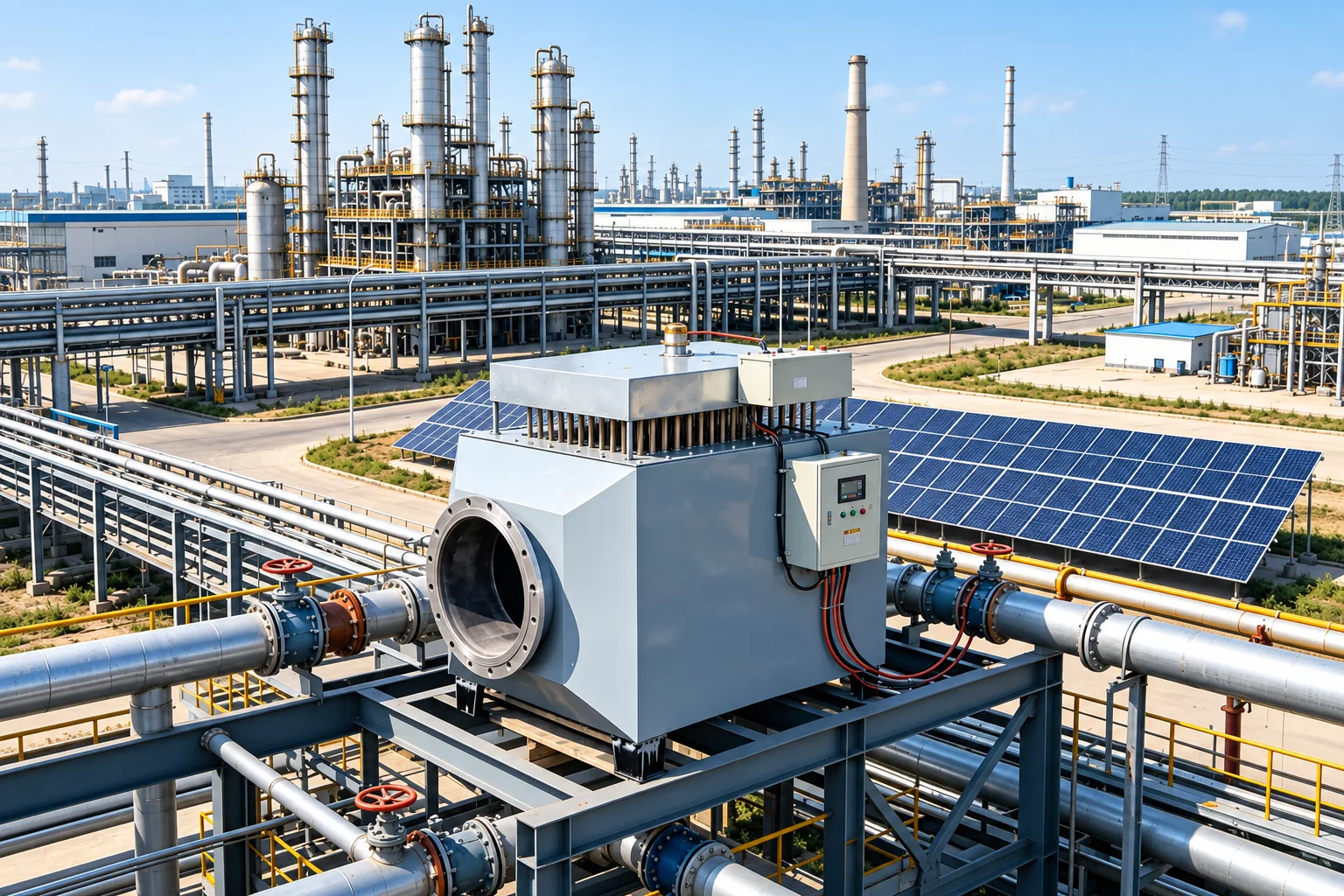
XGTHERMAL delivered a photovoltaic-powered DC electric heating system for industrial air heating, divided into five 100 kW heating groups.
Siemens SIMATIC S7-200 SMART PLC; local / remote operation; DCS interface; Modbus RTU / RS485. Protection includes group-level overtemperature protection and emergency shutdown.
Design and possible compliance routes are evaluated against the final configuration, agreed project boundaries and destination-market requirements. Certification is subject to project review; no ATEX, IECEx or EAC certification is implied.
PV-EH uses electricity generated by photovoltaic modules to supply electric heaters and produce useful industrial process heat. The electrical architecture depends on the source, load, operating strategy and plant interfaces.
PV-DEH describes a photovoltaic-electric heating route using DC electricity within the heating architecture. The term alone does not define which conversion, control or protection equipment is needed.
Yes, when the heating elements, switching, isolation, protection, controls and plant interfaces are engineered for the defined DC supply and process duty.
An industrial heater should not be connected to PV panels without an engineered electrical and control architecture. Voltage and current range, switching, isolation, protection, temperature control and process safety all require review.
No. A DC heating route may not require an inverter in the heater supply path, but the overall project may still require inverters, converters, MPPT or other power electronics. The upstream architecture remains project-specific.
Provide the DC voltage and power envelope, upstream architecture and battery limit, process medium, flow, temperatures and pressure, site conditions, control interfaces, operating philosophy and applicable project requirements.
XGTHERMAL normally engineers the heater-side electrical interface, thermal design, protection, control and plant integration. PV modules, complete PV EPC, site-wide power electronics, BESS or plant-wide EMS are outside the normal supply scope unless specifically agreed.
Share your specifications or drawings with our engineering team.